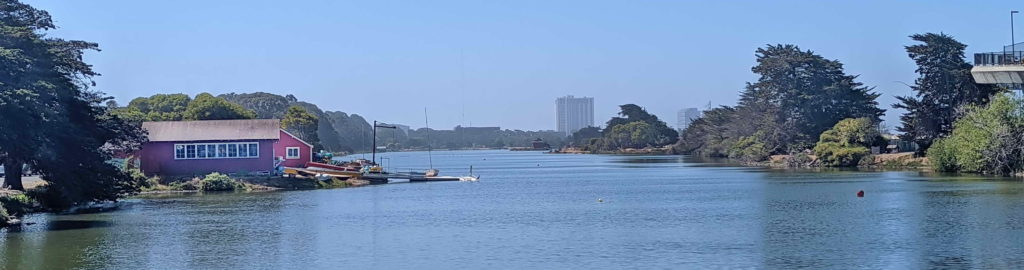
Tree planting at south end of Aquatic Park 9 AM Sat., Oct. 3

Help plant natives at south end of Aquatic Park, 9 AM Sat., Oct. 3
The City of Berkeley invites volunteers to help plant 50 trees, shrubs, and other native plants along the south edge of Aquatic Park’s main lagoon, 9 -11 AM Sat., Oct. 3.
Bring tools and gloves if you have them. Info and signup here. Use 2925 Bolivar Drive for Internet directions.
Shark Stewards Coastal Cleanup, Waterside Workshops Land and Sea fundraising party Sat., Sept. 19
Shark Stewards next monthly cleanup and monitoring at Aquatic Park is set for Coastal Cleanup Day, 10 AM – 1 PM Sat., Sept. 19, at the south end of Aquatic Park’s beautiful but beleaguered lagoons. Meet just west of the gate at the Aquatic Park South lot, 2925 Bolivar Dr. Learn about montoring water quality and the exciting return of sharks and rays to these sheltered waters (see next item). You can walk or cycle from the northern entrances, but by car, enter from Emeryville. Follow Internet maps to the Aquatic Park South Lot (“2925 Bolivar Drive” takes you to slightly more distant parking). RSVPs appreciated, but all ages welcome to just show up. Bring a bag, bucket, gloves, and tongs if you have them, but materials will be supplied.
Also on Sept. 19, Waterside Workshops at the north end of the lagoons hosts its Land and Sea Fundrasing party, named for the Pageant of Land and Sea pageant that launched Berkeley’s first public park welcoming its citizens to enjoy the waterfront. This year’s event (for ages 16 and over) helps Waterside Workshops’ varied youth programs, from job training to wooden-boat building to nature education to bike giveaways. Dinner, dessert, jazz, silent auction, raffle, and more at their beautified campus, with new gardens and a chance to see boat-building and cycle-repair facilities.
Good news: Sharks and rays back, with babies, three years after mass die-off

Shark Stewards are seeing baby sharks and rays in Aquatic Park! This firms up recovery after the mass die-off of of February 2023, and strengthens evidence that these ancient fish give birth here!

Fingers crossed that winter’s forecast strong El Nino will not bring a repeat. Runoff channeled into the lagoons during heavy rains was at least a big part of of the cause in 2023. City action to clear pipes that exchange water with the Bay remains years off, and I-80 runoff continues to flow in from the west.
Transcontinental Railroad changes threaten wetlands important for water quality and sea-level rise threatened — mid August update
This is work in progress due to ongoing work. Please bear with rough edges. Older updates, more photos and documents available; email f5creeks@gmail.com.

In six months, the east side of Aquatic Park from north of Dwight to Heinz has been shorn of decades-old bushes and trees as the transcontinental railroad rebuilt long-rusted tracks.
Large industrial buildings again loom just beyond a steep, bare railroad grade, much as in the 1930s when the park was new. Trains again use the rebuilt tracks. With a possible record El Nino of heavy storms approaching, the loose soil and rock of the steep grade could overwhelm wetlands that help purify West Berkeley’s runoff.


Photos from Dwight Way S: Upper left, 1939: A train on the tracks between industries and the steep grade down to a ditch in the new park, flooded by West Berkeley’s shallow aquifer and high groundwater. Upper center and right, April 2026, before clearing: Over decades, vegetation hid industrial buildings and provided habitat for birds and other small animals. Small creeks carried groundwater the to main lagoon. Below, May 2026, during clearing, with trees and brush stacked on the grade. Newer industrial buildings are visible above wetland that helps purify the still-abundant runoff and groundwater.
Quick history: The busy transcontinental tracks, built in the 1870s, sit on the old Bayshore bluff. The park’s lagoons were hastily built in the Great Depression. Because the railroad owned the shoreline, a feeder to the new Bay Bridge — today I-80 — had to be built on fill offshore. Connecting dredged lagoons to the Bay with pipes kept the trapped finger of Bay from becoming a cesspool of raw sewage and pollution. (Much more on park history here.)
Over decades, thick vegetation watered by the strip of wetland encouraged visitors to think of the land as park. But the Union Pacific Railroad’s land extends west of the tracks. Vital buried sewer, water, fuel, and communications pipelines border both sides of the rail line — particularly a buried fuel line on the west.
The railroad takes back its land: The railroad began planning to rebuild a bottleneck underpass at the Port of Oakland by at least 2000. In 2001, the State Department of Fish and Game agreed not to try to impose requirements designed to protect streams and lakes. Two sets of rusted, unused tracks edging relatively undeveloped Aquatic Park, south of the Dreamland for Kids playground, were the most convenient place to reshuffle trains during the multi-year Port of Oakland project.
Emails and plans show that close attention to refurbishing those tracks began by 2020. Multiple notices to Berleley’s Parks and Public Works Departments were missed or ignored, so there was no input from Berkeley. The railroad’s first application for environmental approval, to the San Francisco Bay Regional Water Quality Control Board, included compensation for damage to Aquatic Park’s wetlands — by planting along the tracks in Albany north of Codornices Creek. Regional Board staff pushed successfully to narrow the project, reducing loss of land in Aquatic Park. But in 2024 the railroad submitted a new application for environmental approvals that would, in their words, “avoid all permanent aquatic resource impacts,” thus requiring no costly mitigation for harming the wetlands destined to be stripped. This was approved by state and federal agencies. A portion of the map approved is below. The complete plan is here. The environmental approval is here — 11 MB).

The approved plan, about a third shown above, supposedly maps the strip of wetlands at the foot of the old shoreline bluff. The blue projections shown as not reaching the lagoon in reality continue as creeks. Water moving downhill from West Berkeley passes through the old shoreline bluff in seeps, springs, or pipes, feeding the wetlands that continue as creeks. Only one of four such creeks fis acknowledged in the plan. (It is not on the plan segment above.) Originating in a large broken pipe through the railroad grade, it is supposed to be protected by a large retaining wall.
The approved plan assumes that environmental harms will be only short term. Except at the lone recognized creek, the railroad is required only to plant or seed small plants from a short list, mainly grasses and rushes — no shrubs or trees. After just five years instead of ten as for mitigation, up to half of vegetation may be invasive and another quarter of the area may be bare. There is no requirement to combat serious pest plants, such as giant cane (Arundo donax) that long provided a warren for illicit camps, toilets, and sex. Previously controlled by volunteers, it is already resprouting.
Missed opportunities, no action to correct mistakes: Regional Board staff were startled to discover from a railroad document that their own agency is officially unaware of any water quality problem in the park’s lagoons. The lagoons are not on the Regional Board’s 303d list of impaired waters because a typo conflated them with San Francisco’s Aquatic Park. Thus legally, as far as the state is concerned, Berkeley’s lagoons are pristine. Abundant finding show, and the city’s many studies and grant proposals point out, that the lagoons are unsafe for body contact or fishing, eutrophying, plagued by scummy algae and die-offs, frequently exceed allowable bacteria levels, are losing depth, and lack adequate circulation and water exchange with the Bay. This limits enforcement action aganst anyone, not just the railroad. Nothing was done to correct this. Water Board staff now say that these changes are on a strict five year schedule — with Berkeley’s deadline just passed.
Below: Berkeley missed notices, and the approved plan left in place deep, sometimes dangerous antique tanks and pipes built for vanished heavy industries. These still shoot pollution into the lagoon in winter — see photos below and aquaticpark.org/connections-and-circulation. The one below Heinz, buried under cut trees and brush during clearing, now has a crushed lid, with water far beneath. Other lids have been left unsecured in the past.


Berkeley’s jarring wake-up: Having missed or overlooked notifications, Berkeley knew nothing of this. Disc golfers sounded the alarm in early April 2026, when they saw construction notices and stakes that threatened their popular course. Hasty meetings with park users, advocates, and agencies seem to have led to a partial settlement that may not yet be written. Disc golfers lost space but no holes.
Parks Department plans and management focus. According to the Parks Department, through grants and direct payment, the railroad will give Berkeley’s Parks Department about $200,000 for around 1000 new trees and other plants, mostly natives. Planting is to begin this winter. Long term, this should bring back some wildlife, especially songbirds, and have some effect on runoff.
Parks Department plans are not so far clearly related to what the Water Board or other agencies may want or require. The Parks Department’s plans and policies, generally focused on recreation and low-cost management, may work against wetlands and federal, state, and local requirements to maintain them. In Aquatic Park, the Parks Department has mowed two previous grant-financed restorations of native plants into oblivion, and native wildflowers and grasses seeded as required by the Board were overrun by weeds within two years. The Department’s ordinary maintenance practices work against wetlands.


Above left, area of cattails mowed by Parks Department. The railroad used this photo to show the standard they need to follow. Does this let both railroad and Parks Department continue? Center, chips dumped in wet places at some point become filling wetlands, which is illegal. Right, after a drinking-water line that had been broken for eight months was finally replaced, the creek and a large swath of loose dirt close to the lagoon shore were left bare until the Water Board ordered at least minimal erosion protection.
Do the wetlands matter? The wide flooded ditch at the foot of the railroad grade, shown in the 1930s photo above, developed into wetlands: a varied, sometimes wide bank of cattails and tules, a couple of lovely ponds, dense and often neglected shrubbery, and multiple seeps and springs with small creeks winding to the lagoon. These became habitat for birds and other small animals. As climate change continues, they seem likely to become important in controlling floods and pushing back against intruding salt water that can corrode infrastructure and poison vegetation.
The wetland also do, for free, the work of rain gardens and bioswales, costing millions and required by state permits. That is, they filter, retain, and reduce West Berkeley’s 150 years of legacy industrial pollutants: PCBs, heavy metals, and hydrocarbons from former West Berkeley heavy industry and the railroad tracks themselves.


Above, a small sample of the varied wetlands. Left, native iris-leaved rush, rare in our urban area, flourishes in sun and shade here. It could largely be wiped out in planned replanting. Center, one of the surprisingly deep ponds. Right, wetlands extend deep into the park in some areas. This one, heading a small stream, begins in ithe broad cleared and mowed area at the foot of the steep, bare railroad grade.
The situation in mid-August: The railroad appears to have completed restoring the tracks, expanding the smoothing the grade, and installing new signals. The tracks are in regular use. Clearing is completed. Cut wood was removed by rail and to the east across the tracks.
The railroad did not keep its promise of a barrier between trashed and erodible areas and intact wetlands. The single roll of coir was and is often misplaced or missing. Tree and brush removal trashed seeps and springs that were the origins of several creeks. As of mid-August, loose dirt and rock loom directly over trashed springs and seeps as well as a long, shallow ditch at the foot of the new grade. No more protection against erosion isrequired until October 31. Even then, only a single layer of jute mesh is required in the face of what may be severe storms.
Below: steep bare earth poised to wash into wetlands and headwaters of the small streams that still flow to the main lagoon.


Below: In some ways, the lone creek recognized in the plan may be faring worst of all. The photo left is one of the unrecognized creeks. Though the tall trees and brush in the background are now gone, it is still much the same. The center photo shows the single recognized creek before clearing, its source a pool below the large rocks on the left. Right, after clearing this source appears to be a large broken culvert through the railroad grade — more long-ago infrastructure. A required future wall to “protect” it may have other purposes.


2027 fiscal year may see first spending from grant for cleaning and fixing some Aquatic Park pipes, but far from certain
Berkeley’s capital-improvements budget includes spending at least part of a $3.8 million grant to strengthen the critical network of pipes that move water into and out of the two larger lagoons, in order to keep I-80 from collapsing and maintain circulation in the lagoons in case of earthquake. The full text of the grant is here. Berkeley’s summary is here,
The grant came from from a short-lived California Transportation Commission (CalTrans) grant program that grew out of the Biden administration’s attempts to spend billions on infrastructure and climate change. The 90-year-old pipes could collapse, blocking Interstate 880-580 and causing disastrous floods. The city has promised an $800,000 match.
Many things remain uncertain. The grant covers strengthening the five main pipes between the main lagoon and Bay, two that connect the main and middle (Model Yacht Basin) lagoons, and what is described as the main connection between the middle lagoon and Bay — but figures and text seem to confuse this with the huge Potter outfall that runs underground just south of the middle lagoon. This square culvert carries more than a third of Berkeley’s urban runoff to the Bay, with side exits to the lagoon that prevent West Berkeley from flooding at the cost of polluting and filling in this lagoon. Large areas now are tide flat at low water.
The amount budgeted is unlikely to pay for construction, especially given inflation. Parks Director Scott Ferris has said that additional federal funds are likely to be needed. Many items in Berkeley budgets are held over for years. Millions of dollars of past studies, including a 1990 Master Plan and the 2002-2012 Aquatic Park Improvement Program, have led to no useful action. The city appears to have cleaned or repaired the tubes only three times since the park opened.
The smallest, southern lagoon is not included in the project. There seems to be general agreement that it should follow the natural course for most such bodies, gradually filling in to become marsh and meadow. It is not connected to the the other two and receives relatively little runoff from inland. Physically hard to get to, it welcomes varied wildlife. Although this lagoon’s pipe to the Bay has been reported broken or partially blocked since at least 1990, its Bay end remains clear of sand (studies say this is due to a quirk of winds, tides, and shoreline angle), Water seems to come and go.
Big thanks for Shark Stewards cleanups, big Bay Festival success, and more; cleanups resume Sun., August 23
Shark Stewards’ monthly cleanups will resume Sun., August 23, probably 10 AM from the south circle. Look for notifications! Congrats to Shark Stewards on their successful season of monitoring (continuing through summer), successful Sunday, April 21 Earth Day cleanup: 61 volunteers including Berkeley High and UC Berkeley students, 7 watercraft, lots of plastic and other litter gone from shoreline and water; and 400 visitors at Shark Stewards’ table at the family-friendly Berkeley Bay Festival at Shorebird Park May 2.
Looking for a way to help nature at Aquatic Park through the summer? Use iNaturalist to observe and record plants and animals, in and near the lagoons, songbirds using trees, insects using plants, changes in and near the recently cleared areas along the tracks….contact f5creeks@gmail.com for info.
Winter Youth Festival at Waterside Workshops Sat., Dec. 13
The Berkeley Parks Department and Waterside Workshops hosts a family-friendly Winter Youth Festival at Waterside Workshops Sat., Dec.13, starting with a 2.3-mile fun run around the park at 11:30 AM (required registration starts 10:30 AM). Games and activities start at noon, from cookie decoration to a bubble show, with food trucks on hand as well as informational booths — from learning about Parks Department camps to helping pick up trash with Shark Stewards. Join a Kiddical Mass Bike Ride across the pedestrian-bicycle bridge to the waterfront at 1:30, with no registration required. More info here.
Next Shark Stewards Cleanup Sun., Dec. 14
Shark Stewards and Friends of Five Creeks have cooperated to help the environment in Aquatic Park’s troubled lagoons since the February 2023 mass die-off of more than 60 sharks and rays, followed by a mass die-off of mussels.
Shark Stewards holds monthly cleanups and monitoring at the south end of the park. Next event: 10AM – 1 PM Sun., Dec. 14. Directions: Meet at the closed gate at the parking circle where Bolivar Drive is blocked at the SOUTH end of the main lagoon. You can walk or cycle from the northern entrances. By car, you need to enter from Emeryville. Follow Internet maps to the Aquatic Park South Lot, 2925 Bolivar Drive. All ages welcome, and all materials supplied, but please bring a bag, bucket, gloves, and tongs if you have them. There also will be opportunities to pick up trash and observe monitoring if you visit Shark Stewards’ booth at the Berkeley Parks Department’s Winter Youth Festival Sat., Dec. 13.
Besides tidying the shoreline and reducing the harmful microplastic particles that threaten human and wildlife health, Shark Stewards records types and brands of what is found — helping with the joint political efforts needed to meet the massive international challenges.
Among other efforts, F5C maintains this web site and invites all to make citizen-science observations using the free iNaturalist app. Unless blocked, these go into the iNaturalist citizen-science project, What Lives in Aquatic Park’s Lagoons.


“Preferred conceptual plan” for replacing Dreamland for Kids, but no money to build

Sept. 20, 2025: Months after funding hopes fell through, a conceptual plan for replacing aging Dreamland for Kids playground in Aquatic Park is on the city’s web site site here. You also can sign up for future updates. The city describes the plan as “remaining true to the original spirit of Dreamland Playground.” Also viewabable here, it shows a large picnic area and new restroom near the entrance, with a spread-out mix of play, picnic, and small lawn areas stretching south beyond the present playground. Towers, a zip line, slides, swings, see-saw, as well as and small areas for play with “nature, ” sand and rocks, and artificial turf are designed to be usable by children of widely varying abilities.

The 25-year-old wooden Dreamland for Kids playground was built and financed largely with volunteer effort organized by nonprofit Berkeley Partners for Parks. It remains popular, but is showing its age and does not meet current accessibility standards. Nearby restrooms and picnic areas also are worn.
In the plan, the long established disc-golf course remains along the lagoon, with a 10′ path for cycling and walking beginning well west of the entrance to the play and picnic areas. The shady raised area with trees also remains.
A narrowed parking area would have space for about 16 cars. What is now its north half would be replaced with a sunken “rain garden” designed to retain and purify a share of the city’s runoff, which now pollutes the lagoon with harmful chemicals, microplastics, and nutrients that fertilize algae growth — these can harm wildlife and are filling in the lagoons. Construction of this part of the project is expected to proceed, with construction expected in 2026. A $1.5-million US Environmental Protection Agency grant is expected to pay half the costs of two centrifugal trash separators east of the railroad tracks as well as the planned rain garden. This area and other watersheds west of the park pollute the lagoon with harmful chemicals, microplastics, and nutrients that fertilize algae growth, can harm wildlife, and are filling in the lagoons. The approved grant proposal is here. More information on the plan is here.
Developers’ preliminary interest in redevloping a neighboring office complex sparked hope that this would pay part of the cost of improvements. The Berkeley Commons lab building, then under construction to the north, had paid for street repaving, shoreline restoration, new trail and picnic areas, tree plantings, promised public art, and more. A consultants’ process launched in fall of 2024 included two online community meetings, “pop-up” workshops, and a walk. But with economic headwinds and loss of federal funds, Berkeley now faces looming budget cuts. The $250-million Berkeley Commons remains empty and West Berkeley is awash in vacant lab space. Like many city projects, a new Dreamland has been suspended. According to the Parks Department email, “The City is currently seeking funding to complete the design and construction of the playground and surrounding area improvements.”
Tend the new trees Sat., May 31
Volunteers helped plant more than 1000 new trees and large shrubs on the west side of Aquatic Park in the last year! Help them thrive, support songbirds, lessen freeway noise, and transform this underused side of the park by joining in weeding and mulching on 9:15 AM – 1 PM Sat., May 31. Lunch included! All ages welcome! Meet at the Kenneth A. Hayes Boathouse at the southwest end of the main lagoon. Info here. You can walk or bicycle from either end, but with a car, use the south entrance. Map here. You can cycle or walk from the main, north entrance, but by car you need to go into Emeryville and double back to the parking circle where Bolivar (also called Shellmound and Bay Street) is blocked. Map here. Signup and details here.
Big step toward understanding water-quality challenges, thanks to Ava Community Energy

A small new device is recording key measures of water quality in Aquatic Park’s main lagoon — a step to understanding and curing the die-offs and smelly algae blooms that plague the popular park and its wildlife.
On May 24, nonprofit Shark Stewards‘ David McGuire and interns installed the HOBO logger well beneath the waves. It is now recording temperature, salinity, and dissolved oxygen with batteries that last for years. Results, read every few months with a cell phone, are to be made public and shared with Berkeley’s Public Works and Parks Departments. This should help with understanding the park’s challenges: polluted urban runoff, limited circulation through long-neglected pipes, and complex flood risks that could affect large areas of West Berkeley as climate changes.

A $2,500 Community Stewardship grant to volunteer group Friends of Five Creeks from Ava Community Energy, Berkeley’s green-energy supplier, paid for the device. Both F5C and Shark Stewards work with student interns gaining experience for environmental careers. Monitoring with this state-of-the-art device will boost this training.
Shark Stewards shoreline cleanup set May 11; cleanups and monitoring getting good results
Since January, Shark Stewards, working with UC Berkeley students from the Ocean Society and Cal Surfrider, have removed thousands of pieces of litter in cleanups focused on the park’s south end. The next cleanup is set for 10 AM- noon Sun., May 11. Meet at the closed gate where Bolivar Drive is blocked at the SOUTH end of the main lagoon. You can walk or cycle from the northern entrances, but by car, you need to go south to 67th Street, cross the tracks, and then go back north on Shellmound/Bay/Bolivar (all the same street) into the park. If the circle at road’s end is full, there is parking a short distance south.
Students also are monitoring water quality, using a handheld device from piers. No serious problems found so far this spring! Find out more at Shark Stewards table at the Berkeley Bay Festival, Sat., Apr. 26, at Shorebird Park in the Marina.
Big grant for cleaning, strengthening tide tubes
Berkeley has been promised a $4.1 million grant to clean and strengthen the pipes that connect Aquatic Park’s main and middle lagoons with each other and the Bay, improving circulation and lessening the chance that the connections would collapse and block Interstate 80. This was the final grant from a CalTrans program financed mainly by Biden adminnistration programs meant to deal with climate change, and ended a year early as administrations changed.
Construction remains years away. Complex permitting from CalTrans and the East Bay Regional Park District will be required. Additional federal funds may be needed for construction under I-80.
The connections have been almost unchanged since the park was created in the Great Depression, except that later landfill west of I-80 blocked circulation from the north end. During the Great Depression, building the first version of what is now I-80, so that cars could reach the then-new Bay Bridge, had cut off a long, shallow finger of Bay, turning it into a cesspool. The pipes were installed and park created to solve this problem. Periodic algae blooms and fish die-offs have plagued the park since its early years, however. Silt from city runoff, steadily making the middle lagoon shallower, limits flow through several pipes. (Find Background, maps, and photos on the circulation challenges here. More than 40 years of studies are here.)


A tough invader gone — for now!
From a Berkeley Project work day in November 2024 (left) to a February 2025 finish (below), UC Berkeley volunteers, weed warriors and, in a final push, volunteers from Congregation Beth Israel dug out a huge clump of invasive giant cane (Arundo donax) near the south end of the main lagoon. We expect some roots were missed. Big thanks to our wonderful interns, and to the Berkeley Parks Department for picking up green waste and promising to cut the fast-growing canes.
Good news for Aquatic Park water monitoring!
In more progress, Ava, Alameda County’s green energy provider, is honoring Friends of Five Creeks us with $2500 Community Sponsorship to purchase automated water-quality monitoring equipment for Berkeley’s Aquatic Park.
We expect to partner with Shark Stewards, with most work done by interns training for future environmental careers! With the most up-to-date equipment, we will be able to continuously measure temperature, dissolved oxygen, and salinity, contributing to building baseline data for climate change and to help with management of this beautiful and heavily used 100-acre park. Aquatic Park’s lagoons, like many such human-made water bodies, have been troubled almost since their creation with recurrent algae blooms and wildlife die-offs; they must also be managed to avoid flooding. Climate change is likely to add to these challenges.
Tour Dreamland Playground area with biologist 10AM – 11AM Thursday, Jan. 30, emphasizing existing natural resources and native plant/pollinator habitat enhancement possibilities at and near a replacement playground. A “pop-up workshop” also will give opportunities to comment on two alternative conceptual designs. No signup needed — meet at Aquatic Park at Channing Way or nearby Dreamland entrance — notice does not say, but they’ll be easy to spot! Info here.
A survey asking your ideas on second-round concepts for the area closes Jan 31. , Link is here. At a Dec. 12 second online meeting on redesigning the Dreamland for Kids playground, consultants introduced two fairly detailed conceptual designs: “Dreamland Reimagined,” focused on fantasy-themed play structures (below left), and “Land and Sea Playground” with more spread out, naturalistic play (below right). (Download larger graphics here; additional background and graphics here , as well as lower on this page (scroll down).


Waterside Workshops/City of Berkeley annual waterside festival Dec. 7 saw 100 kids get free bikes (plus helmets) from Street Level Cycles’ annual giveaway (right). Also food, activities, and fun including a bike parade (below right) and drawing a favorite critter — inspired by Friends of Five Creeks’ big poster of life from sky to lagoon bottom (below left).


Nov. 25 Berkeleyside article outlines that Berkeley Commons lab building, Addison to Bancroft east of Aquatic Park, is still empty amid glut of West Berkeley lab space. Link here.
Nov. 2 Volunteer planting launches Bolivar Drive improvement: Trails, tables, more
About 60 volunteers, including UC Berkeley students from the Berkeley Project, planted close to 300 trees and other natives along Aquatic Park’s shorelines on Sat., Nov. 2.
The event officially opened improvements along Bolivar Drive including new trails overlooks, and picnic areas, plus permeable surfaces to keep pollution out of the lagoon. The improvements were mostly paid for by the Berkeley Commons lab developers, who have pledged to maintain them for some years.) Information and flyer here from a more in-depth walk Oct. 27.


At the main lagoon’s south end on Nov. 2 and 3, Friends of Five Creeks and UC students volunteering with the Berkeley Project removed a huge stand of invasive giant cane, Arundo donax, along with acacias and fennel.
Friends of Five Creeks interns’ shoreline observations also provided new information for this website on what lives in the lagoons, water circulation, and instability.
Send your ideas on replacing Dreamland for Kids playground by Nov. 8: About 30 people “attended” an Oct. 8 Zoom presentation on replacing Aquatic Park’s 24-year-old Dreamland for Kids Playground, including reconfiguring nearby paths, picnic areas, and restroom. (Scroll down for pictures and background.)
Consultants got lively feedback on three concepts. Now, the city wants your reactions to these, as well as other ideas, by Nov. 8. You can see the consultants’ presentation here (big file — be patient), scroll down to the three concepts, and then fill out a survey here. With ideas that don’t fit the survey, email here.
Big changes for the Dreamland for Kids area? With $300,000 from the city’s General Fund, the Parks Department plans to design a replacement for the Dreamland for Kids playground, north of where Channing would be if it crossed the tracks. The big wooden play structure — largest in the city — was among collaborations throughout the nation between landscape architect Robert Leathers and local volunteers. Aquatic Park’s effort was spearheaded by Berkeley Partners for Parks, who chose placement and details and, along with Parks staff, organized hundreds of volunteers of all ages to do much of the construction.
The popular playground shows its 20+ years and does not meet modern accessibility standards. Parks Director Scott Ferris says that the city is working with staff and on-call landscape architects, with public input perhaps six to eight months off. A new playground would have to mesh with other changes: A new grant to reduce runoff pollution promises a 10,000-square-foot rain garden or “bioswale” in the present parking area (scroll down for more info).
The three acres just north of the parking lot, also bordered by Bolivar Drive, Bancroft, and the railroad tracks, may be redeveloped as laboratories similar to those still under construction just to the north. Woodstock Development of Burlingame has approached the city about replacing the 50-year-old, one story buildings dating from the 1970s. This would require planning forpedestrians, cyclists, and cars on the narrow strip between the property and the lagoon; emergency access and evacuation; the planned large bioswale, and future rising groundwater and possible flooding.


Volunteers help plant new forest on west side of Aquatic Park: The little-used west shore of the main lagoon, polluted by freeway noise, has a new forest intended to lessen noise and draw people and birds. The area has about 1,200 new plants, plus an irrigation system to help with maintenance. According to Ian Kesterson, city forester, about 300 trees will get quite large if they survive; about 300-400 would be small trees or large shrubs at maturity, and others are smaller shrubs or groundcovers.

Students from nearby Black Pine Circle day school — 120 of them, from kindergarten to eighth grade 11 — volunteered around the lagoons on the school’s April 19 Pace Seeds of Change service day. Groups helped at Waterside Workshops and Bay Area Outreach and Recreation Program (BORP), picked up trash with Shark Stewards and park staff, and weeded and pruned in the hummingird and butterfly garden next to Dreamland for Kids playground with Friends of Five Creeks (left, handing the big bags of weeds over the fence for pickup).
In January, contractors planted 100 trees edging the freeway (left) and installed irrigation to keep the new plants alive (center). At volunteer events Feb. 3, Mar. 9, and Apr. 6, hundreds helped with planting and mulching. Costs, more than $300,000, came from a CalTrans/state Natural Areas grant to mitigate freeway impacts, the Bayer Fund, and about a sixth from the Berkeley Parks Tax.

Tile mural planned: In October, the Civic Arts Commission chose Masako Miki’s proposed tile mural, with elements from Ohlone and Japanese folklore, for a $700,000 project to beautify what is now a plain concrete wall between the north end of the Aquatic Park main lagoon and the city’s animal shelter. All proposals for a larger art project along the main lagoon were rejected; the Commission plans to write a new description and seek new proposals.
Grant for urban-runoff treatment for Bancroft-Channing approved: The US Environmental Protection Agency has approved a $1.5 million grant to pay half the cost of $3 million in improvements to treatment of urban runoff from near the west ends of Channing and Bancroft to Aquatic Park, a small part of polluted discharges to the lagoons from the city.
The project is expected to include a 10,000 square foot “rain garden” in the present parking lot next to Dreamland for Kids playground and centrifugal trash separators at Channing and Bancroft east of the railroad. These could also be designed to reduce inflows of smaller particles. The grant proposal is here. The work would lessen pollution from two “microwatersheds” that drain small areas in West Berkeley directly to the main lagoon – a small fraction of the polluted urban runoff to Aquatic Park’s lagoons. An overall view of circulation and urban runoff in the Aquatic Park lagoons is here.